
Briefing by Ketan Joshi, climate analyst and energy researcher. August 25th 2026, Oslo Norway.
Summary
- The fossil fuels sold by Equinor in 2025 alone will bring about between 34,000 and 58,000 additional human deaths (compared to a world in which they were never burned)
- This is in stark contrast to Equinor’s windfall profits, which has made more money from energy crises and conflict than ever before.
- Products sold since 2018 will cause between 260,000 to 450,000 additional deaths; 2 to 3 times the population of Stavanger
- Norway’s historical and potential future produce use emissions could cause nearly 3 million deaths; more than half of Norway’s population
- Equinor argues its fossil fuels should be sold on moral ground, for ‘energy security’. This briefing argues the company should use that same moral logic to stop selling a product that is deadly at the scale of mass global warfare or genocide.
Using historical data compiled from Equinor’s annual reports, use of Equinor’s sold products adds up to 2,000 megatonnes of CO2-e since 2018. The use of these products will cause between 260,000 and 450,000 additional deaths. This is equivalent to 2 to 3 times the population of Stavanger.
Introduction: energy crisis and climate crisis in Europe
Europe is now deep into its second fossil-fuelled energy crisis of this decade. After Russia’s invasion of Ukraine triggered a massive spike in energy prices in 2022, America’s attack on Iran and the subsequent closure of the Strait of Hormuz have caused a crippling price crisis for energy users around the world, but a clear opportunity for Norway’s fossil fuel exporters.
“Norwegian offshore production plays an important role in ensuring energy security in Europe,” Terje Aasland, Norway’s energy minister told the Guardian (1). Aasland went on to say:
“The world, and Europe, will have a need for oil and gas for decades to come and it is crucial that Norway continues to develop its continental shelf to remain a reliable and long-term supplier … and (with) a high level of exploration activity.”
“In Europe, before the war in Ukraine, there was much talk of how to get rid of oil and gas on our continental shelf … now they ask me every day ‘can you deliver more oil and gas’? We are talking about energy security for Europe and we have to increase investment. We have a responsibility. Our focus is very clear”
Norway benefited greatly from the first fossil fuel crisis of the 2020s. As this occurred, Europeans were forced to pay cripplingly high bills for energy - cash added to Norway’s . During that crisis, every European citizen sent 150 euros ($175) to the United States per year and the same to Norway, according to a report by the Centre for Research on Energy and Clean Air (CREA) (2).
Figure 1 - Norway’s incredible fossil fuel export earnings
Caption: Norway’s fossil fuel revenue has grown significantly this decade, as the flipside of cripplingly high energy prices and unaffordability for end users.
Source: SSB 08792 External trade in goods, main figures (NOK million), by month and trade flow, updated July 2026 (3)
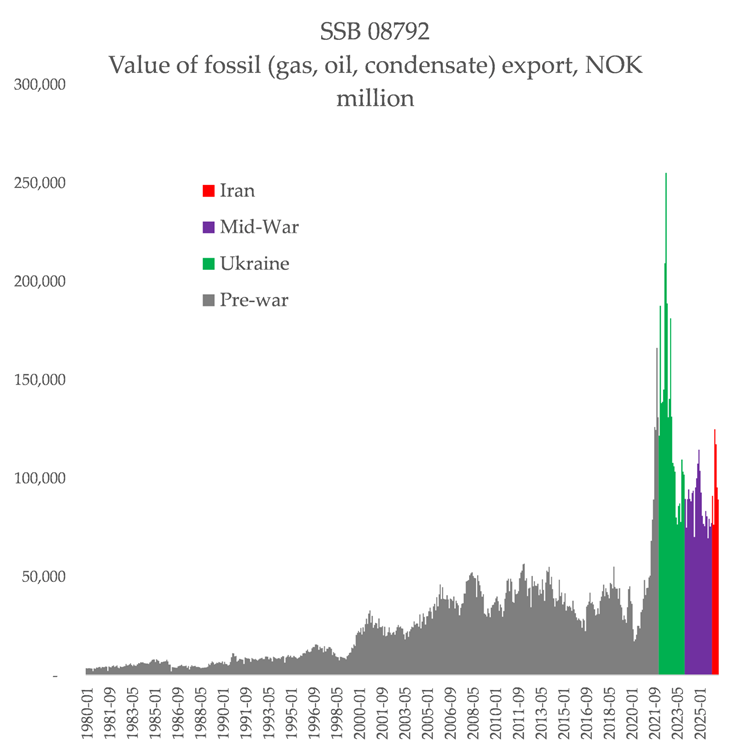
According to Norway’s statistics body SSB, from January 2020 to July 2026, Norway has earned 7,093,099 million NOK in fossil fuel export revenue; more than than the previous 14 years combined. Norway has earned just over 2 million NOK per minute from fossil fuel exports, in the 2020s. 2026 will either end up as the second highest or third highest month in terms of fossil fuel revenue in Norway’s history.
Equinor’s revenues have already seen significant increases, according to their latest quarterly reports. “The reported net operating income of USD 12.99 billion is up from USD 5.72 billion in the same quarter last year”, stated Equinor, in their second quarter report (4). Norwegian media outlets frequently focus their coverage (5) of the company on the financial benefits reaped both by the company and the Norwegian state by the sale of fossil fuels during a crisis that enables massive financial returns.
Part 1: Equinor’s fossil fuel products have enormous human costs
When Norway sells oil and gas, primarily through state-owned fossil fuel company Equinor, those products are combusted by customers to unlock their energy content. Climate science tells us (6) that combustion causes the heating of Earth’s atmosphere, and that in turn causes a collection of flow-on impacts with serious and extremely significant impacts on nature, and on human life.
This narrow focus on financial benefits should be rebalanced by examining the deeply researched human consequences of fossil fuel use, and a tentative apportionment of that to the fossil fuel products Equinor is selling increasing quantities of.
There is a broad array of research linking fossil fuel company’s product sales to the consequences of climate change. One recent study found that Equinor’s emissions (7) significantly contributed to 213 heatwaves analysed by the researchers, making those heatwaves more intense. Nearly a quarter of those heatwaves could have been caused solely by Equinor’s own emissions.
Greenpeace Norway’s trial against the Norwegian state, challenging three major oil fields, and one cited expert found that “2,708,271 children born between 2010 and 2020 will experience an extra heat wave as a result of the warming from emissions from Tyrving, Breidablikk and Yggdrasil” (8)
There is a strong pre-existing literature examining the deadly consequences of fossil fuel combustion. A landmark study published in 2021 by Daniel Bressler (at Columbia University’s Earth Institute and the university’s School of Public and International Affairs) found that “For every 4,434 metric tons of CO2 that we add beyond the 2020 rate of emissions, we will kill one person”, specifically due to temperature-related mortality (9) (around 225 deaths per megatonnes of carbon dioxide equivalent, MT CO2-e).
Another estimate published in 2024 (building on Bressler’s work) by Greenpeace (10) puts the number at around 138 additional deaths for every megatonne of CO2. A pre-print paper co-authored by Curtin University expert Professor Peter Newman estimates cumulative climate deaths per cumulative megatonnes of carbon dioxide equivalent between 448 to 1089, with a 95% confidence; a figure they state is likely an under-estimate.
In their latest sustainability data Equinor (11) disclosed the use of their sold products caused 257.8 megatonnes of carbon dioxide equivalent greenhouse gas emissions (a 3% rise on 2024).
Using the lower and middle ranges of mortality estimated presented above (between 138 to 225 deaths per megatonne of greenhouse gas emissions), the use of Equinor’s sold products last year will result in between 34,000 and 58,000 additional human deaths in the future, compared to the world in which those fossil fuels were not burned.
Using historical data compiled from Equinor’s annual reports, use of Equinor’s sold products adds up to 2,000 megatonnes of CO2-e since 2018. Again applying the mortality costs of carbon to this, the use of these products will cause between 260,000 and 450,000 additional deaths. This is equivalent to 2 to 3 times the population of Stavanger.
In the space of time taken to read this briefing note up to this point, Equinor will have sold enough fossil fuels to cause approximately one additional human death in the future, through their normal use.
Previous efforts to assign consequence to carbon emissions have produced a ‘social cost of carbon’ (SCC) metric; many of which have been criticised for under-stating the true financial cost of climate impacts. However, a recent Columbia Climate School (12) analysis found including the financial cost of human mortality puts the SCC at around $258 USD, compared to previous estimates around $37 USD.
Previous efforts to assign a social ‘cost’ to carbon emissions have been rightly criticised for low-balling the numbers, but including the mortality cost of carbon increases the previous value of $37 per tonne to $258.
What this means is that for Equinor’s net operating income (13) of $5 billion in 2025, a social cost of $66 billion will be incurred. Every million US dollars in profit made by Equinor in 2025 will also cause six additional future deaths, as a result of the use of Equinor’s sold products.
Since 2018, Equinor has made nearly $67 billion USD in net income. But the use of the products they sold to earn that cash will cause $516 billion worth of damage, when you account for the real harms.
A recent analysis (14) published by Global Witness found that Equinor is responsible for the production of 8.66 gigatonnes of CO2 emissions since 1972, when it was founded as Statoil. These greenhouse gas emissions will end up causing between 1 to 2 million additional human deaths; nearly twice the population of Oslo. If you add Global Witness’ estimate of Equinor's future emissions (5.17 GTCO2), this brings the potential death toll of Equinor’s fossil fuel product sales to nearly half Norway’s population (3 million people).
While there will always be uncertainty behind the precise number of lives lost to fossil fuel impacts, the magnitude of avoidable death occurring due to fossil fuel use is undeniable. The deadly impacts of atmospheric overheating have played out across Europe this summer, with many thousands (15) of people losing their lives to the extreme heat.
Conclusion - Equinor’s petroganda distracts from the severe, deadly impacts of its products
Norway’s government and Equinor both place weight on the moral importance of supplying oil and gas to Europe, on the grounds that ‘energy security’ helps protect lives, and denies revenue to Russia’s fossil fuel sales. The same moral imperative does not exist around significantly reducing the use of fossil fuels through cessation of exploration and the active support of oil and gas use reductions across Europe.
-------------------------------------------------------------------
1 Guardian, 2026 https://www.theguardian.com/world/2026/may/09/norway-oil-and-gas-production-shortages-middle-east-ukraine
2 CREA, 2026, page 13 https://energyandcleanair.org/wp/wp-content/uploads/2026/08/CREA_EU-CO2-emissions-fossil-fuel-imports_2025_Final.pdf#page=13
3 SSB, 2026 https://www.ssb.no/en/statbank/table/08792
4 Equinor, 2026 https://www.equinor.com/news/equinor-second-quarter-2026-results
5 NRK, 2026 https://www.nrk.no/nyheter/equinor-med-sterkeste-resultat-pa-over-tre-ar-1.17965492
6 IPCC, 2023 https://www.ipcc.ch/report/ar6/syr/resources/spm-headline-statements
7 Quilcalle et al, 2025 https://www.nature.com/articles/s41586-025-09450-9
8 2024, Greenpeace Norway https://www.greenpeace.org/norway/nyheter/klimaendringer/klimasoksmalet-lagmannsretten-oppsummering/
9 Bressler, 2021 https://www.nature.com/articles/s41467-021-24487-w
10 Greenpeace, 2024 https://www.greenpeace.org/static/planet4-italy-stateless/2024/01/072945d6-todays-emissions-tomorrows-deaths.pdf
11 Equinor Sustainability Data Hub, Accessed August 2026 https://sustainability.equinor.com/climate
12 2021, Columbia Climate School https://news.climate.columbia.edu/2021/07/29/more-carbon-emissions-will-kill-more-people-heres-how-many/
13 Macrotrends Equinor net income data; accessed August 2025 https://www.macrotrends.net/stocks/charts/EQNR/equinor/net-income
14 Global Witness, 2026 https://globalwitness.org/en/campaigns/fossil-fuels/burning-bridges-assessing-equinors-alignment-with-a-15c-pathway/
15 World Health Organisation, 2026 https://www.who.int/europe/news/item/11-06-2026-statement---europe-lost-200-000-people-to-heat-in-4-years-yet-nearly-all-of-them-were-preventable


