
Article by Ketan Joshi, climate analyst and energy researcher. October 19th 2026, Oslo Norway.
Equinor's incredible marketing victory
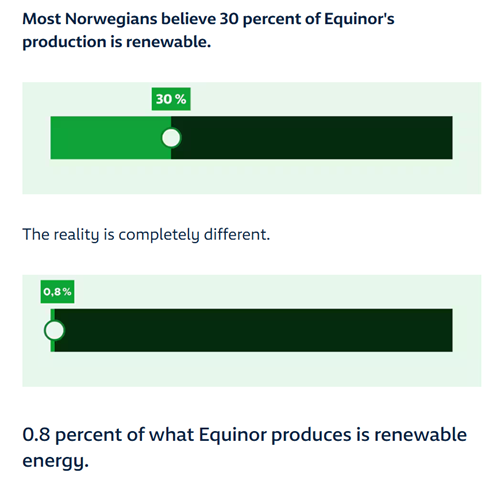
An absolutely mind-boggling new survey has just revealed the enormous gap between Equinor’s actual amount of renewable energy sales (0.8%), and the public perception of what that proportion is: a whopping 30%. It’s a testament to the marketing skills of Norway’s biggest company.
Back in 2020, Norway’s state-owned fossil fuel company Equinor joined an already-crowded field of fossil fuel companies promising to hit ‘net zero’ emissions. In their sustainability report from that year, the company promised to reach a share of 4% of renewable energy sales by the year 2026, notably by increasing their renewable energy installed capacity from 0.5 gigawatts in 2019 to between 4 and 6 gigawatts in 2026. Equinor also promised to produce between 35 to 60 terawatt hours of renewable energy.
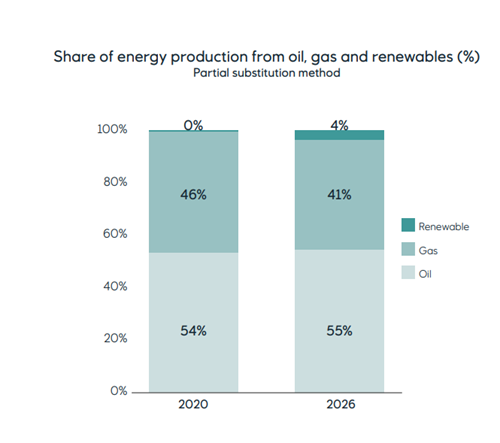
In that report, Equinor declared that “to avoid an irreversible climate crisis, urgent actions are needed to reduce greenhouse gas emissions from all sectors to help society move towards net zero”. This all ties in with Equinor’s 2018 effort to undergo a massive rebrand, changing their name from ‘Statoil’ in a $33m marketing spree to present themselves as a ‘broad energy company’. "The decision reflects that Statoil is developing itself into a broad energy company in line with global developments in the energy sector," then Oil and Energy Minister Terje Soeviknes told Reuters at the time.
Well, it’s 2026. There are two numbers we have to check in on. The first is how well Equinor have done on their 2026 percentage target. As Equinor’s own data show, they reached a share of 0.8% in 2025, which has barely budged so far in 2026:
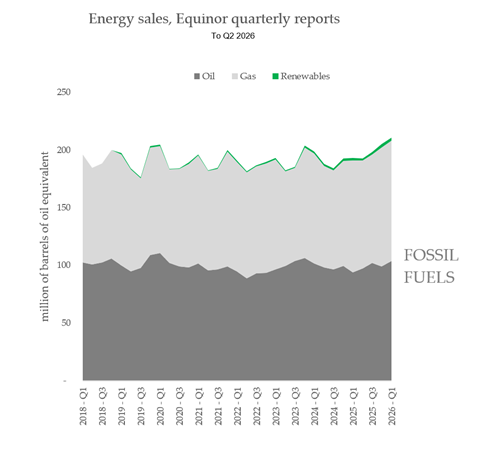
Their renewable energy capacity did increase, but only to 1.38 gigawatts; far from the 4 to 6 promised back at the start of this decade. For production, which is how much energy was produced by those renewables, this is how things are looking:
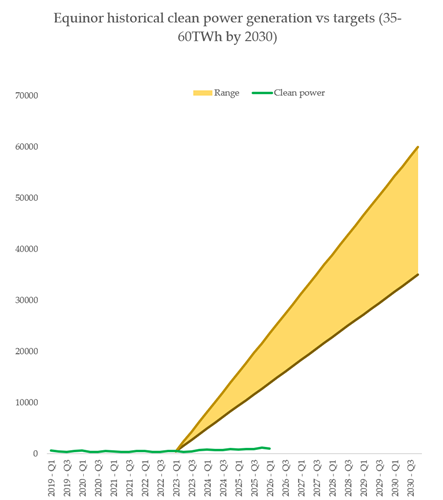
I remember writing a blog post in 2021, and being genuinely surprised no one had actually calculated what Equinor’s share of renewable energy sales is, meaning I had to do it myself using their quarterly reports. Why hadn’t anyone actually checked the numbers for this company?
That brings us nicely to the second thing we should check on, which is the real reason those targets were set, names were changed and marketing created. What impact did this vision of Equinor as a ‘broad’ energy company investing heavily in renewables actually have on Norway’s perception of the company?
As mentioned earlier, a new survey from NRK, Norway’s state-owned independent broadcaster, found that Norwegians believe Equinor’s share of renewable energy is actually 30%, not 0.8%
NRK also analysed Equinor’s Facebook pages, and found the company uses the word “energy” more than oil or gas, and even uses the word ‘wind’ more than ‘oil’. As a rhetoric researcher interviewed by NRK for the article said: “energy is smart. It embraces everything, hides oil and gas and gives positive emotions. That is the rhetorical power of the word energy”.
Remarkably, Equinor’s head of communications said in the article and again in a TV interview that the number isn’t a true reflection of Equinor’s efforts, and that more renewables will come online in the future. This is an absolutely remarkable thing to say, barely months after Equinor formally scrapped its renewable energy target, something which wasn’t brought up during the interview. Equinor’s CEO happily admitted that “We haven’t really pursued those targets for several years”, and told journalists that there had probably been more attention to the renewable targets outside the company than within.
Equinor will point their communications efforts at whatever suits the moment we’re in. In 2020, it was a climate moment, and so they published targets and statements to suit that moment while they just kept doing what they’ve always done.
In 2026, we’re in a time of conflict, war and instability. The key talking point from fossil fuel companies is, bafflingly, the argument that at a time when reliance on unreliable and vulnerable oil and gas supply chains is causing price pain around the world, we should simply be increasing the supply and reliance on fossil fuels. It is counter-intuitive, but the line works when Equinor seeks to sell its fossil fuels to nervous European customers.
If NRK surveyed Norwegians about whether reliance on fossil fuels increases or decreases energy security, we’d see a similar disconnect from the reality that fossil fuels are causing the pain, rather than protecting us from it.
As Accela Research wrote,
”EQNR remains a transition laggard among the European majors. The company has cut its renewables target, stepped back from CCS, reduced low -carbon capex, increased oil and gas capex, raised production guidance and increased buybacks. It has not abandoned transition in the way BP has, but the direction is clear: EQNR is moving further towards a hydrocarbon led strategy”
The public perception of Equinor as a ‘broad energy’ company in Norway is a shockingly powerful testament to the power of marketing and communications, and perhaps a sign that much more needs to be done to persistently share the real nature of the company. You can see the shock on the faces of the people asked by the journalist in NRK’s article, and our task is taking that effect and bringing it to far more people.


